|
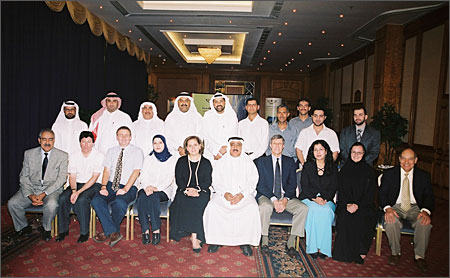
Keeping in view the involvement of foreigners
in the workplace in Bahrain, Ahlia University,
in association with International Center for Management
and Research, Inc. organized a three day workshop
“Managing in a Multicultural Environment.”
This workshop was conducted at the Gulf Hotel,
Bahrain on the 2nd, 3rd and 4th of October, 2004.
The principal facilitators who conducted this
workshop are an eminent team of professionals
who have academic, consulting and business experience
in different parts of the world: Professor Gary
Ferraro and Professor Samira A. El-Sayed. Professor
Gary Ferraro is Professor Emeritus of Anthropology
at the University of North Carolina, USA and has
served as the Director of the Intercultural Training
Institute at UNC-Charlotte, a consortium of cross
cultural trainers/educators from academia and
business. Professor El-Sayed got her B.S. in Sociology
from Ein Shams University. She is a visiting Professor
at Ahlia University. She has worked as a full
professor of Psychology and has gained a unique
set of qualifications and experiences, which enable
her to present and discuss the nature, characteristics,
challenges and barriers of interacting in diverse
cultural environments.
The purpose of the workshop is to gain a fuller
understanding of the role of cultural differences
in managing in a diverse cultural environment.
The workshop is intended for
Chief executives, division heads, executives and
staff of any organization employing personnel
from diverse cultures, or dealing with others
from different cultures.
The workshop explored a number of vital issues
related to better understanding of the cultural
dimensions of management. The workshop took a
threefold approach to understanding the cultural
dimension of managing in a multicultural environment
namely A Cultural-general Segment, A Culture-specific
Segment and Understanding Communication Patterns,
Verbal and Non-verbal.
The methods of workshop instruction used spanned
group discussions, viewing and analyzing of videos,
analyzing case studies and group problem-solving.
Knowledge and subject-matter expertise was disseminated
in a positive and supportive environment in which
all participants interacted in and contributed
to the workshop.
As is well-known, the performance of an organization
entirely depends on the performance of its workforce
as a well knit team. To achieve this, each organization
that employs workforce from different cultures
and geography has to train its staff how to manage
in an organization in which multicultural environment
is a reality. The need for this training is felt
acutely in the Kingdom of Bahrain inasmuch as
it serves as the hub of banking activity in the
Arabian Gulf and an important cosmopolitan centre
in the Middle East
Participants agreed the workshop represented an
opportunity for many organizations to add value
to their management function in the sphere of
multicultural training.
|


 Home


 Admission
Application

 Tution
& Fee Payment